For decades, gothic tattooing was synonymous with heavy, dense tribal blackwork, thick biker crossbars, and dark, muddy shadows that demanded immense physical endurance. Over the past several years in our studio, I have watched a breathtaking aesthetic renaissance take hold. The dark romance, architectural grandeur, and introspective symbolism of gothic art have merged seamlessly with the precision of single-needle fine linework. Exploring curated gothic fine line tattoos today is about trading heavy black ink blocks for delicate engraving strokes, needle-thin crosshatching, and cathedral-grade elegance.
What makes fine-line gothic ink so captivating is its ability to balance emotional gravity with visual lightness. Inspired by 16th-century copperplate woodcuts, Victorian mourning jewelry, and sacred architectural traceries, these pieces look like vintage engravings lifted straight from the pages of an antique grimoire. Because the linework is whisper-thin and relies heavily on strategic skin breaks, you can wear a substantial, deeply symbolic piece without it dominating your silhouette like a solid black stamp. Below, I have curated 15 studio-grade gothic fine-line tattoo ideas, complete with architectural backstories, ideal placements, and technical needle advice to guide your next dark romance masterpiece.
01. Gothic Cathedral Lancet Window with Pointed Tracery

Medieval ecclesiastical architecture provides endless inspiration for fine-line ink. Lancet windows, with their soaring pointed arches, trefoils, and delicate stone traceries, capture the grandeur of European gothic cathedrals. Rendered with needle-thin precision, the architectural geometry elongates the limbs while balancing negative space breaks with crisp stonework crosshatching.
- Design Concept: A soaring 13th-century pointed arch window featuring ornate clover trefoils, lancet stone dividers, and subtle stained glass etching.
- Ideal Placement: Forearm vertical axis, center spine, or outer calf where the natural bone length complements the tall arch.
- Artist Technique: Constructed using a 3RL needle for the structural stone arches and an extra-tight 1RL for interior window crosshatching. We avoid heavy black packing so the stone appears illuminated by moonlight.
02. Victorian Memento Mori Skull with Death Head Moth

The Latin phrase memento mori reminds us to remember our mortality and cherish the fleeting nature of life. This Victorian-inspired composition pairs a photorealistic human skull with an outstretched death head hawkmoth perched across the forehead. Fine-line stippling gives the bone an aged parchment patina without the aggressive harshness of traditional blackwork.
- Design Concept: An anatomically accurate human cranium viewed in three-quarter profile, crowned by a detailed hawkmoth with open filigree wings.
- Ideal Placement: Outer bicep, upper thigh, or center chest below the collarbones.
- Artist Technique: We render bone sutures and nasal cavities using low-voltage whip shading with 20% grey wash. Skull highlights are carved out with untouched bare skin breaks.
03. Ornate Baroque Coffin Entwined with Thorny Black Brier
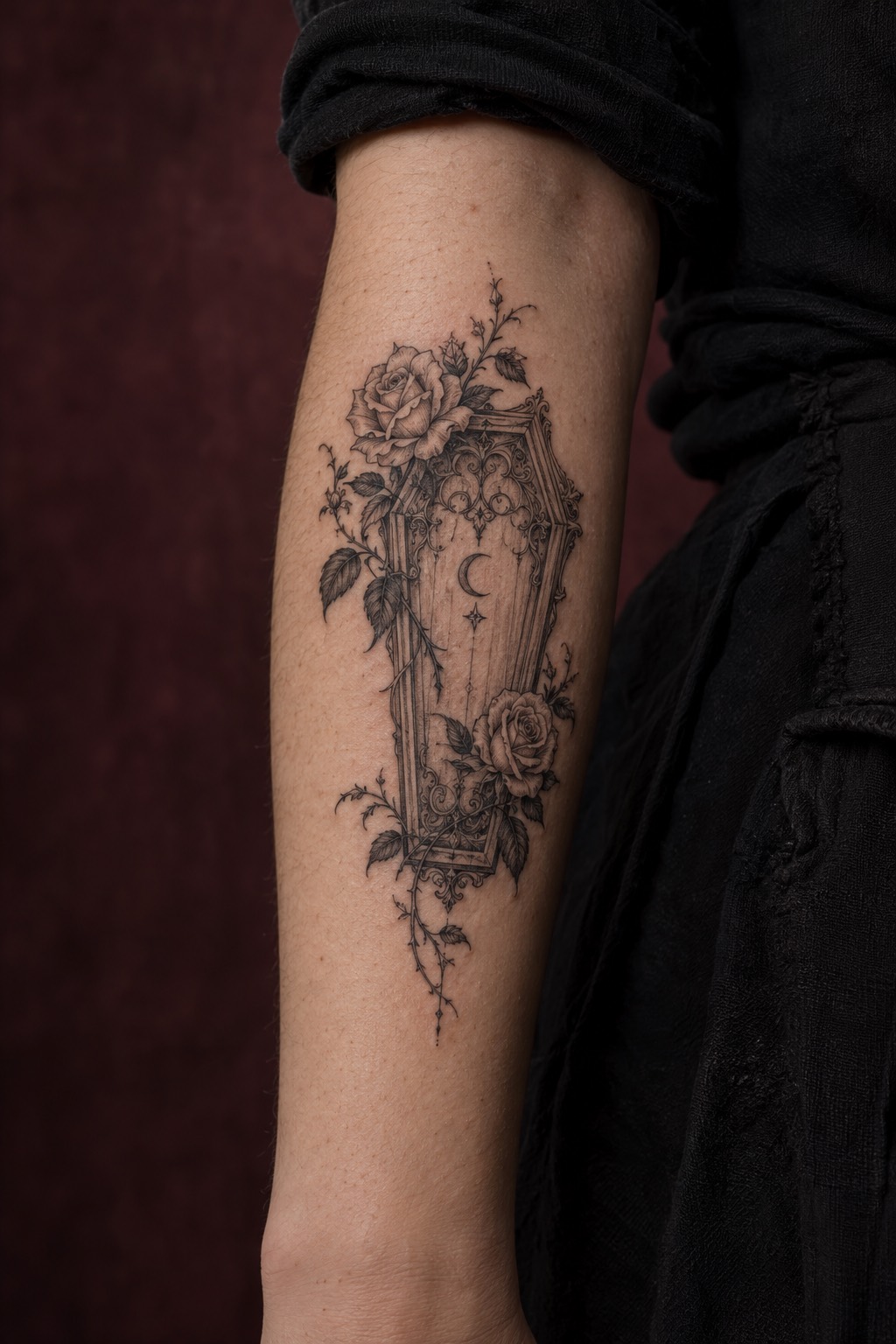
Romanticizing the macabre is central to the gothic aesthetic. An antique six-sided toe-pincher coffin, decorated with baroque handles and an embossed crucifix, is enveloped by creeping wild rose vines with oversized thorns. It evokes classic vampire folklore and Victorian cemetery romance with quiet sophistication.
- Design Concept: A Victorian filigree coffin casket framed by twisting thorny rose briers with dark wilted petals falling from the base.
- Ideal Placement: Inner forearm, side of the calf, or ribcage.
- Artist Technique: Executed with a 5RL for the coffin wood perimeter and a 3RL for the brier thorns. Delicate woodgrain textures are drawn with featherlight hand speed to keep the wood subtle.
04. Notre-Dame Stone Gargoyle Perched in Silhouette

Gargoyles and grotesques have guarded stone parapets for centuries, believed to ward off malevolent spirits. This design captures a winged chimera perched stoically on an ornamental cathedral cornice, surveying the nocturnal city below. Fine-line stippling and etched crosshatching give the creature the weathered texture of century-old French limestone.
- Design Concept: A winged gothic gargoyle hunched on a carved stone balustrade with folded bat wings and reflective hollow eyes.
- Ideal Placement: Back of the shoulder, outer upper arm, or side ribs.
- Artist Technique: Pointillist dotwork using a 3RL builds stone weathering across the creature horns and talons. Diluted washes mimic the organic streaking of rainwater down antique stone.
05. Pierced Sacred Heart with Thorn Crown and Radiant Rays

Gothic religious iconography carries deep dramatic pathos. A stylized anatomical heart, wrapped tightly in barbed thorns and pierced by a jeweled rapier, emits sharp geometric solar rays. It serves as an evocative emblem of fierce devotion, emotional vulnerability, and enduring inner resilience.
- Design Concept: An illustrated anatomical heart pierced diagonally by an ornate dagger, encircled by thorny vines and radiating needle-thin halos.
- Ideal Placement: Center sternum, upper chest, or inner bicep.
- Artist Technique: The dagger blade is pulled with a single confident 5RL stroke, while the bleeding ventricles and fine ray halos are mapped with an ultra-thin 3RL for sharp ecclesiastical contrast.
06. Victorian Wrought-Iron Cemetery Gates and Weeping Willows

Evoking atmospheric midnight walks through historic European burial grounds, ornate cemetery gates symbolize boundaries between the conscious world and the unseen realm. Intricate iron scrollwork, sharp spear-point finials, and cascading weeping willow branches create an enchanting gothic landscape that moves organically with the body.
- Design Concept: A partially open Victorian cemetery gate with scrolling filigree hinges, draped in delicate willow foliage and autumn mist.
- Ideal Placement: Forearm wrap, upper back across the shoulder blades, or outer thigh.
- Artist Technique: Black ironwork demands saturated, clean line joins. We use a 5RL for the iron gate frames and drop down to a 1RL for the gossamer weeping willow leaves and distant headstones.
07. Skeletal Praying Hands with Antique Rosary Filigree

Subverting classic devotional tattoo art, this piece replaces flesh with slender bone phalanges. Two skeletal hands clasp together in quiet reverence, draped with an antique beaded rosary and an ornate gothic crucifix. The contrast between sacred prayer and skeletal remains delivers a potent memento mori message.
- Design Concept: Anatomically detailed skeletal finger bones in prayer, interwoven with dangling rosary beads and a miniature baroque crucifix.
- Ideal Placement: Inner forearm, upper outer arm, or lower leg.
- Artist Technique: Carpal and metacarpal joints require delicate shadow contouring. We employ soft stipple shading with a 3RL to simulate bone density without making the skeleton look muddy.
08. Woodcut-Style Raven Perched on a Quill and Grimoire

Drawing direct inspiration from Edgar Allan Poe and 16th-century German woodcut engravings, this piece features an intelligent corvid perched atop an ancient leatherbound grimoire. Sharp, etched hatch lines mimic vintage printing press book illustrations, giving the piece an antique literary charm.
- Design Concept: A raven with glossy black-feather texture perched on an antique spellbook, complete with a feathered writing quill and ribbon bookmark.
- Ideal Placement: Outer bicep, upper forearm, or outer thigh canvas.
- Artist Technique: Woodcut etching requires precise parallel hatch strokes. We use a 3RL needle at consistent hand speed, ensuring line spaces are wide enough to remain distinct as the ink settles.
09. Fractured Blackletter Typography with Flourished Serifs
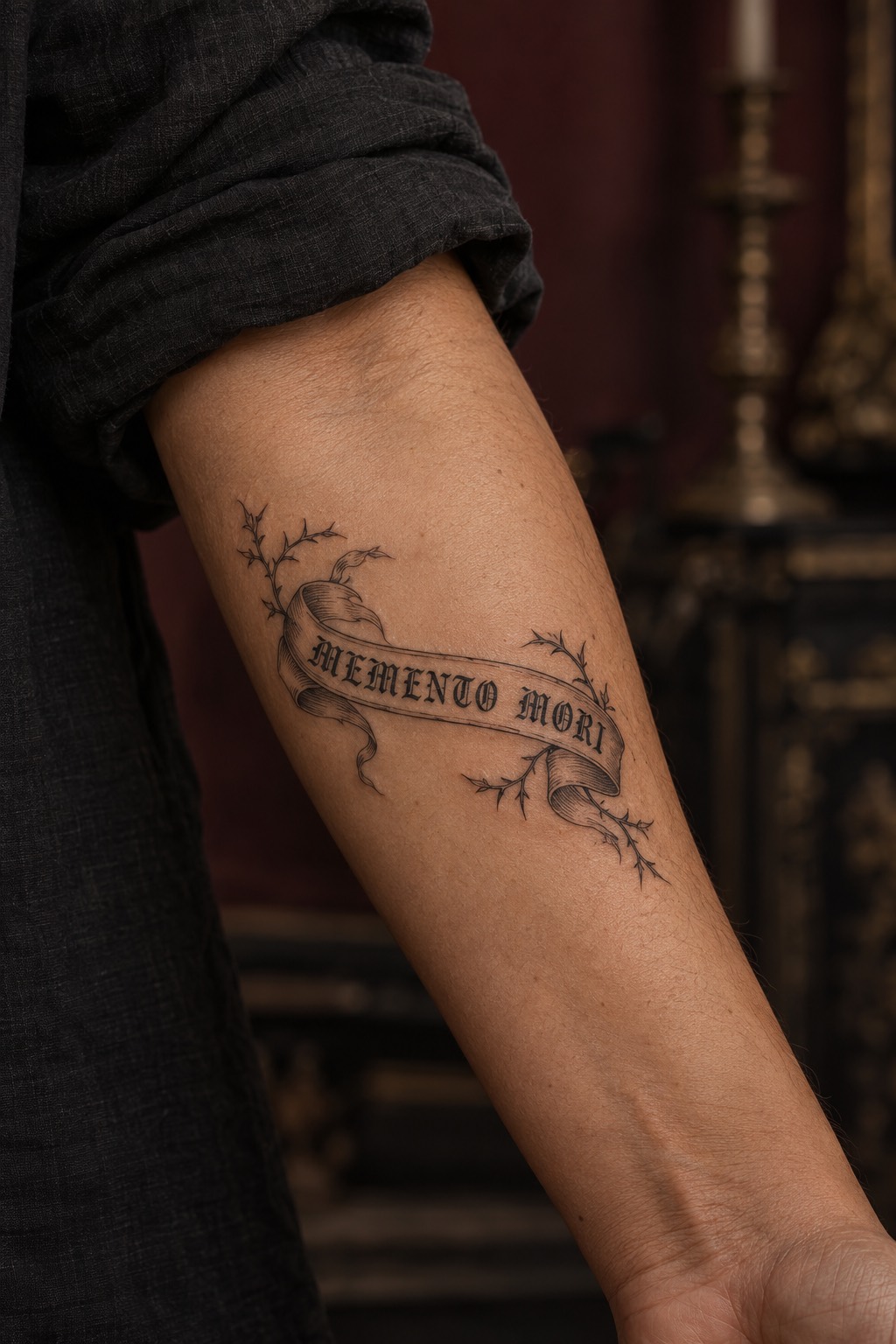
Gothic Fraktur and Old English calligraphy carry unmatched historical power. Instead of heavy, blocky street script, modern fine-line blackletter uses razor-thin flourishes, hairline serifs, and subtle ornamental spurs. Whether spelling out a meaningful personal mantra or a single word, it reads like calligraphy from an illuminated medieval manuscript.
- Design Concept: Custom hand-drawn Fraktur lettering with razor-thin ornamental flourishes, diamond-shaped tittles, and delicate serif loops.
- Ideal Placement: Forearm horizontal or vertical axis, collarbone line, or down the spine.
- Artist Technique: Line weight modulation is the key to calligraphy. We use an angled hand stroke with a 5RL for downstrokes and a 3RL for upward hairline flourishes, preventing the letters from bleeding together.
10. Botanical Deadly Nightshade and Poison Belladonna Sprig

Gothic botany celebrates the dark allure of toxic, nocturnal flora. Atropa belladonna, with its bell-shaped flowers and glossy poisonous berries, carries ancient folklore of witchcraft, seduction, and mystery. Fine-line etching captures the delicate venation of its leaves while keeping the poisonous berries glossy and alluring.
- Design Concept: A wild sprig of deadly nightshade featuring open nodding flowers, delicate berry clusters, and intricately veined foliage.
- Ideal Placement: Wrist, outer forearm, collarbone, or side of the neck.
- Artist Technique: We use dense black fill with bare skin highlights for the poisonous berries, paired with whisper-soft single-needle shading for the bell-shaped petals to maintain airy botanical elegance.
11. Gothic Candelabra with Dripping Tallow and Wisp Smoke
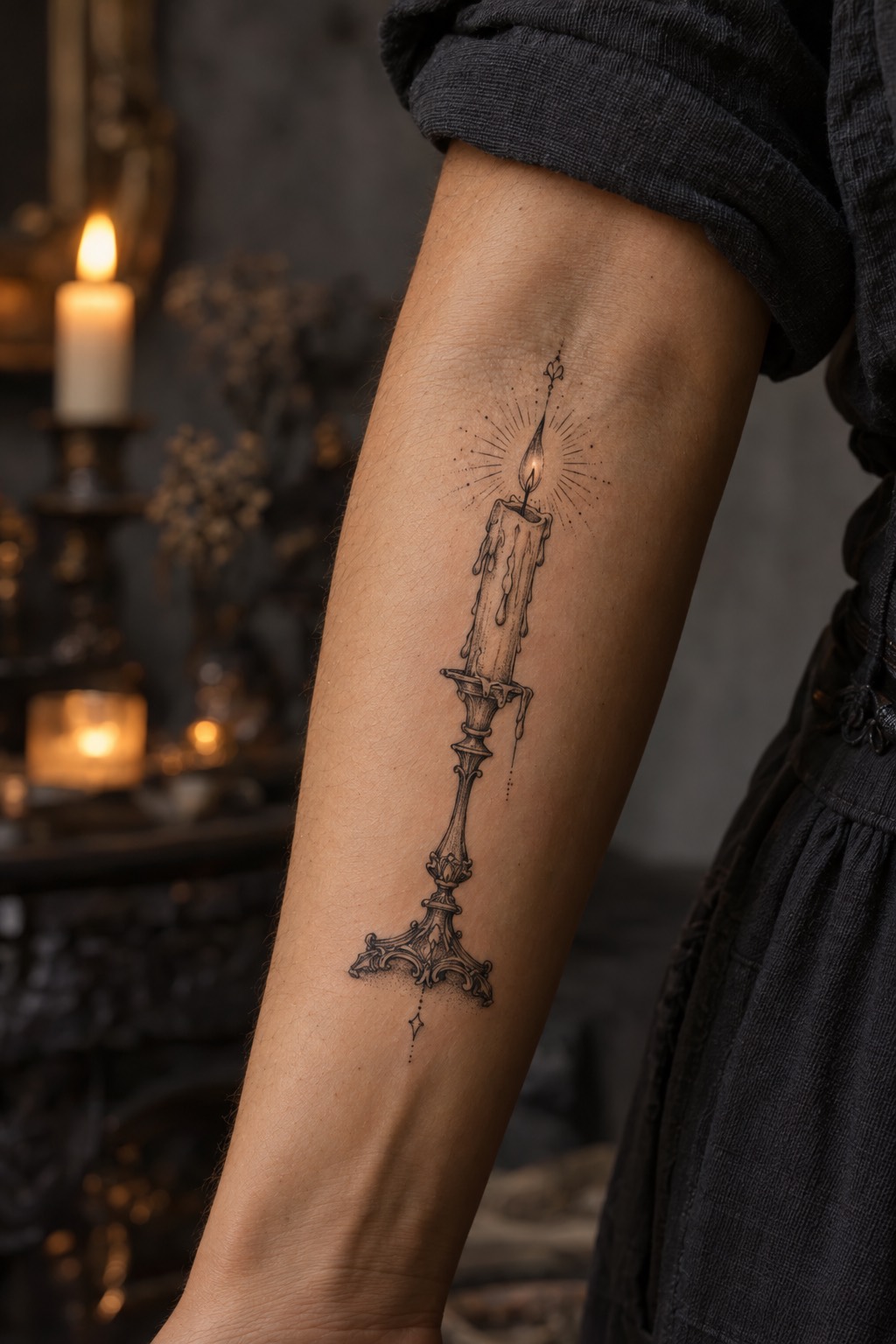
A flickering candle in the dark represents hope, illumination, and the fleeting passage of time. An ornate, tarnished bronze candelabra holding melting wax tapers, complete with curling wisps of smoke rising toward the ceiling, evokes secret libraries and midnight séances. The undulating smoke ribbon softens the structured brass geometry.
- Design Concept: An antique branched candelabra with melted wax drips running down the stem and curling fine-line smoke tendrils drifting upward.
- Ideal Placement: Inner forearm, upper arm, or calf.
- Artist Technique: Smoke ribbons demand subtle gradient management. We use a 1RL bugpin with 10% grey wash, allowing the smoke to dissolve seamlessly into natural skin tone.
12. Stylized Fruit Bat with Victorian Filigree Moon Halo
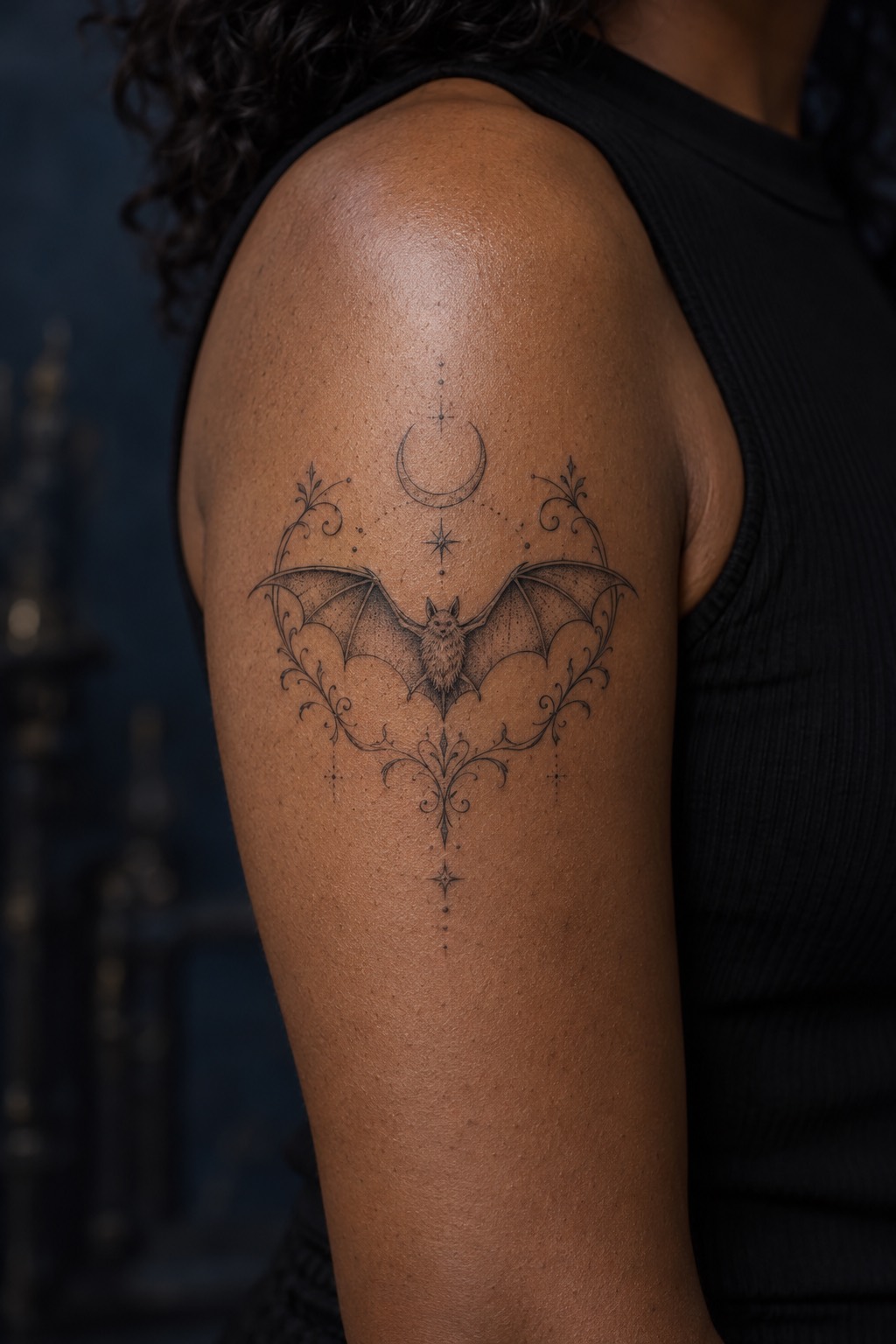
Often misunderstood creatures of the night, bats represent keen perception, nocturnal freedom, and personal rebirth. This concept features a flying fruit bat with translucent, veined wings curved gracefully around an ornamental crescent moon halo. It balances gothic intrigue with enchanting anatomical delicacy.
- Design Concept: A dynamic bat in full flight, framed by an ornate Victorian filigree moon and microscopic stippled star constellations.
- Ideal Placement: Center upper back, sternum, or outer shoulder.
- Artist Technique: Wing bones are outlined with a 5RL, while the translucent wing webbing is shaded using rapid whip-hand movement with a 3RL to simulate stretched leathery membrane.
13. Renaissance Weeping Angel Gravestone Monument

Found across the Victorian cemeteries of London and Paris, weeping angels sculpted from marble capture profound grief and poetic peace. An angel with draped classical robes, bowed head, and feathery folded wings weeping over a stone pedestal translates into a hauntingly gorgeous fine-line masterpiece on the skin.
- Design Concept: A classical weeping angel monument with outstretched feathery wings, weeping into folded arms atop a carved stone plinth.
- Ideal Placement: Upper arm bicep, outer thigh, or shoulder blade.
- Artist Technique: Micro-realism drapery requires smooth carbon wash gradients. We use a curved 9-magnum running very soft for cloth folds, and a 3RL for crisp feather outlines.
14. Ornate Handheld Mirror with Spiderweb Cracked Reflection

Mirrors have long been surrounded by supernatural lore, from repelling vampires to capturing reflections of the soul. A heavy baroque silver hand mirror with an ornate filigree handle contains a web of fractured, spiderweb cracks across the glass. It speaks to shattered illusions, self-reflection, and dark fairytale romance.
- Design Concept: An antique baroque handheld mirror framed by acanthus leaf flourishes, featuring fractured spiderweb glass cracks.
- Ideal Placement: Forearm, outer calf, or side ribcage.
- Artist Technique: The intricate frame features dark contrast shading, while the mirror glass relies on crisp, hairline fractures pulled with a 1RL needle against untouched skin.
15. Medieval Ouroboros Serpent with Alchemical Sigils

An ancient symbol of eternal return, destruction, and cyclic recreation, the ouroboros depicts a serpent or dragon swallowing its own tail. Enclosed within the circular body are intricate alchemical sigils representing transformation and esoteric knowledge. The circular balance makes it visually arresting from every angle.
- Design Concept: A coiled medieval dragon-serpent eating its tail, accented by sharp scales, horned head, and interior alchemical geometric sigils.
- Ideal Placement: Inner forearm, upper chest, back of the calf, or nape of the neck.
- Artist Technique: Precise scale definition demands patience. We use a 3RL for individually articulated scales and crosshatched alchemical circles, ensuring sharp geometry that stays intact over years.
The Evolution of Gothic Ink: From Heavy Blackwork to Delicate Micro-Etchings
Understanding the visual history of gothic design helps you collaborate more effectively with your tattoo artist during the custom design phase:
- The Influence of Albrecht Dürer and Copperplate Engravings: Classic gothic fine line borrows directly from Renaissance woodcuts and copperplate etchings. Instead of smooth airbrushed grey washes, volume and shadow are achieved through parallel hatch lines, stippling, and cross-hatching. This technique gives the finished tattoo an authentic antique artifact aesthetic.
- Embracing Architectural Hierarchy: Gothic architecture relies on soaring verticality, symmetry, and pointed arches that draw the eye upward toward the heavens. Placing architectural pieces along natural anatomical vertical lines (such as the forearm, spine, or calf) flatters your natural proportions and elongates the body.
- Dark Themes with Poetic Restraint: Modern gothic tattoos reject cartoonish horror in favor of poetic melancholy. Pairing sharp imagery like skulls, daggers, or coffins with soft organic elements like climbing ivy, blossoming nightshade, or gossamer moth wings softens the composition and makes it visually timeless.
Preserving Needle-Thin Black Pigment and Avoiding Premature Blur
Fine-line black ink requires specialized studio application and dedicated home aftercare to ensure those microscopic details stay razor-sharp over years of skin renewal:
- The Critical Role of Line Spacing: The greatest technical risk in fine-line gothic tattoos is overcrowding. Because all tattoo ink spreads microscopically over the decades as your macrophages interact with pigment, lines placed too close together will eventually blur into a dark smudge. An experienced fine-line artist will maintain intentional negative skin gaps between crosshatch lines to preserve lifetime legibility.
- Consistent Needle Depth Over Bone: Gothic designs frequently feature stark structural elements placed over bony zones like the sternum, spine, or ribs. Inexperienced tattooists often push too deep on thin skin, causing blowouts. Ensure your artist specializes in high-precision, low-trauma rotary fine-line tattooing with proven healed photos.
- Lifelong UV Defense for Pure Black Wash: UV light is the ultimate destroyer of fine-line carbon pigment. Sunlight breaks down carbon particles, turning crisp black lines into hazy grey marks. Once your gothic tattoo completes its 3 to 4 week epidermal healing cycle, apply a broad-spectrum mineral SPF 50 sunscreen over the ink every time you step into natural sunlight.