In the world of bespoke tattooing, the shoulder cap is one of the most rewarding and visually dynamic placements on the human physique. Anchored over the rounded dome of the deltoid muscle, this canvas naturally acts like ceremonial armor, an ornamental epaulet, or a sculptured architectural crest. In my studio, client requests for shoulder cap tattoos consistently surge because the placement offers the ideal harmony between bold visual presence and effortless discretion. A well-designed deltoid piece commands attention in a sleeveless top or swimwear, yet conceals completely beneath a standard t-shirt collar and sleeve.
However, tattooing the shoulder cap requires a deep understanding of kinetic human anatomy. The deltoid is not a flat sheet of paper. It is a hemispherical muscle that flexes, stretches, and rotates whenever you raise your arm, reach forward, or carry weight. An amateur tattooist will often place a flat stencil that warps into an awkward oval the moment you relax your posture. An experienced artist, by contrast, maps the design to hug the muscle curvature, ensuring petals, sacred geometric rings, and serpentine coils flow naturally with your body. Below, I have gathered 15 studio-tested shoulder cap tattoo ideas, complete with exact design concepts, anatomical flow guides, and professional advice to help you plan your next statement piece.
01. Sacred Mandala Deltoid Cap
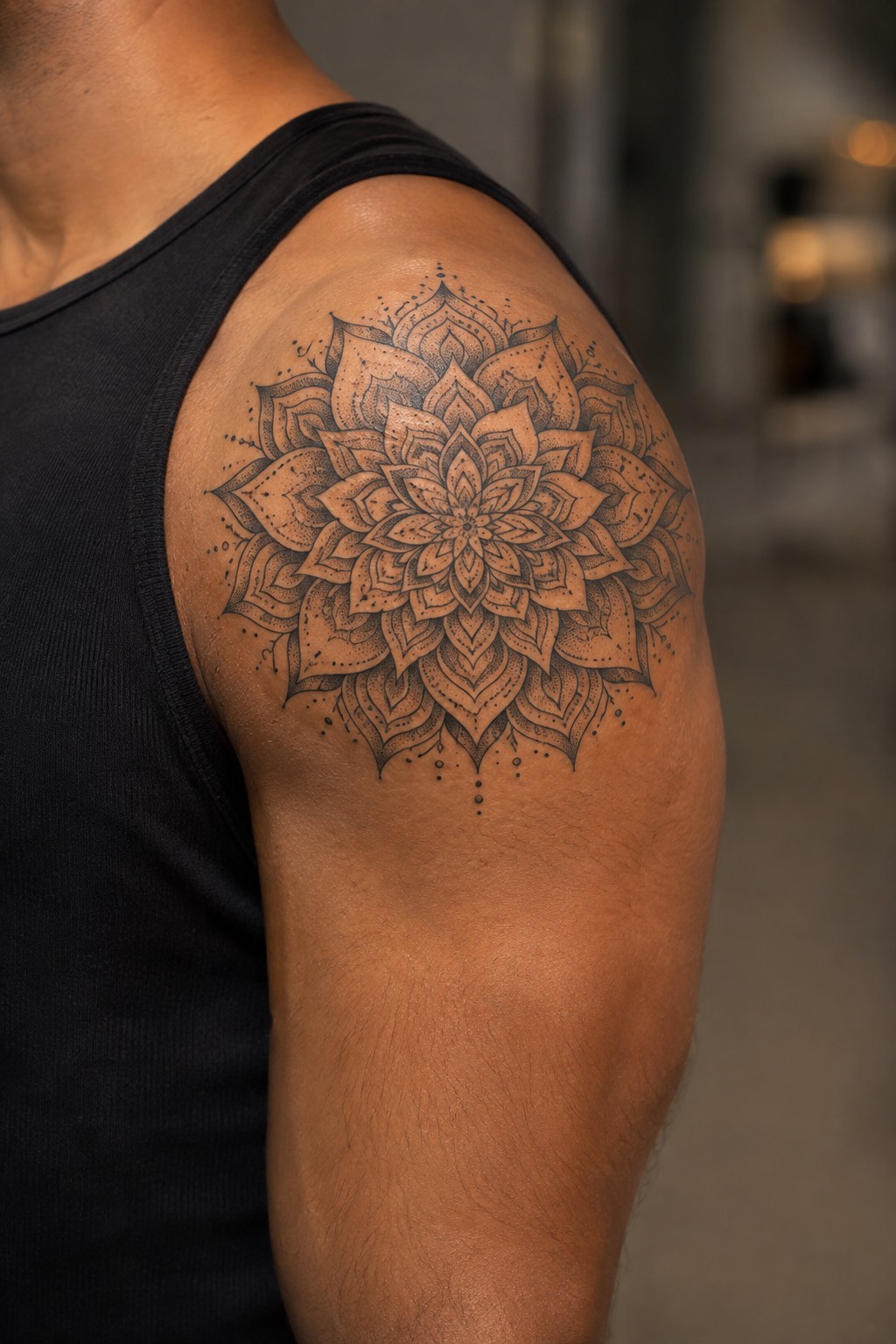
The natural hemisphere of the deltoid muscle provides a tailor-made spherical canvas for circular geometry. Anchoring a complex sacred mandala directly over the apex of the shoulder allows the concentric petal rings to bloom outward, naturally curving around the front, side, and rear heads of the muscle. Rather than fighting bodily curves, the sacred geometry uses the shoulder joint to create an illusion of a three-dimensional embossed stone shield.
- Design Concept: A central floral mandala surrounded by graduating geometric rings, sacred lotus petals, and pointillist dotwork fringes.
- Anatomical Flow: The focal core rests over the acromion process, with outer petals draping symmetrically down over the lateral deltoid.
- Artist Technique: We apply the stencil with the client standing tall and arms hanging naturally at their sides. Lines are pulled with a steady 5RL for structure and a 3RL bugpin for internal dotwork gradation.
02. Lush Botanical Peony Dome
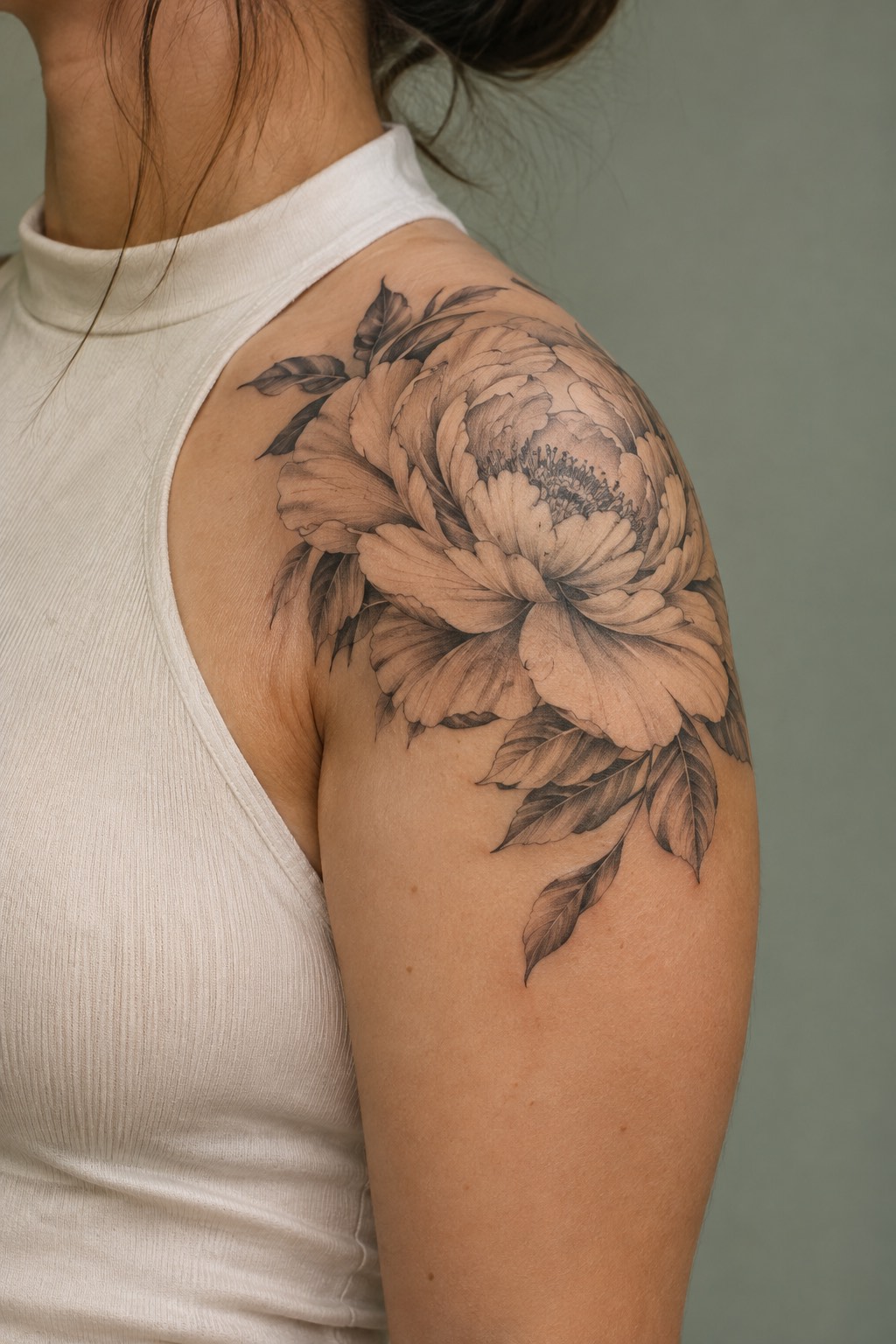
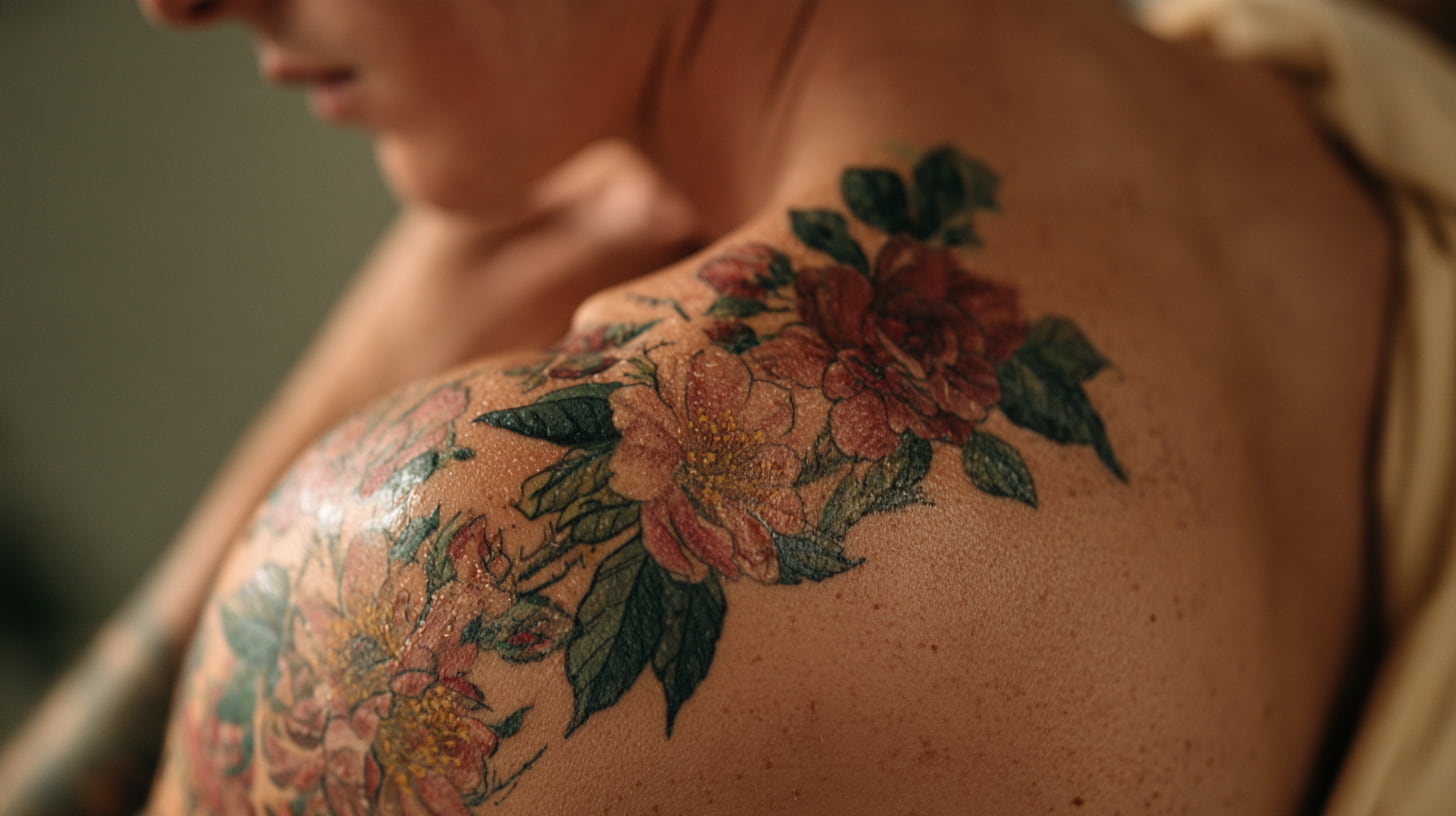
Peonies are beloved in tattoo artistry because their ruffled, multi-layered petals effortlessly adapt to curved anatomy. A lush peony head centered on the shoulder cap drapes its outer petals over the clavicle, upper chest, and tricep boundary. The organic foliage softens muscular transitions, creating a romantic, botanical crown that looks effortless from every viewing angle.
- Design Concept: An oversized blooming peony blossom flanked by budding wild roses, curling botanical leaves, and falling petals.
- Anatomical Flow: Curves naturally from the top of the trapezius over the shoulder round and tapers toward the upper bicep.
- Artist Technique: Using a combination of tight 3RL needle outlines and featherlight 10% to 30% grey wash whip shading, we give the petals velvety softness without harsh perimeter borders.
03. Ornate Baroque Armor Epaulet with Hanging Filigree
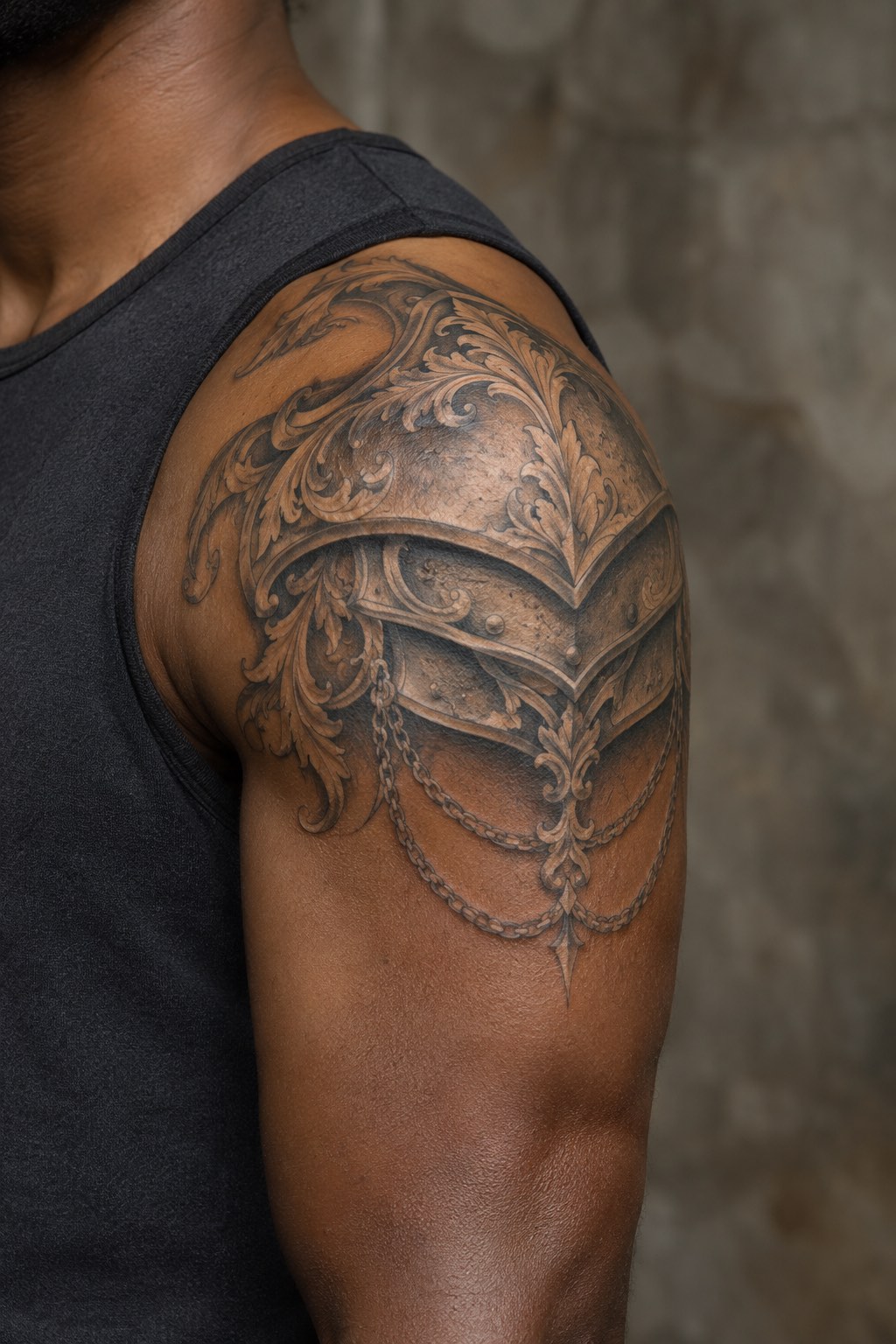
Drawing inspiration from medieval ceremonial armor and Victorian royal epaulets, this piece transforms the shoulder into wearable metalwork. Scalloped acanthus leaf scrollwork, embossed steel plates, and cascading faceted jewel swags frame the arm like permanent heirloom couture. The hanging filigree beads sway visually with your natural arm movement.
- Design Concept: Gothic baroque plate armor flourishes paired with hanging chandelier crystal drops and intricate beaded garlands.
- Anatomical Flow: Hugs the curve of the deltoid like an authentic pauldrons armor piece, ending just above mid-bicep.
- Artist Technique: Rich black packing with a curved magnum needle creates metal depth, while bare skin highlights along the filigree rims mimic cold, polished silver.
04. Coiling Japanese Ryu Dragon Wrap
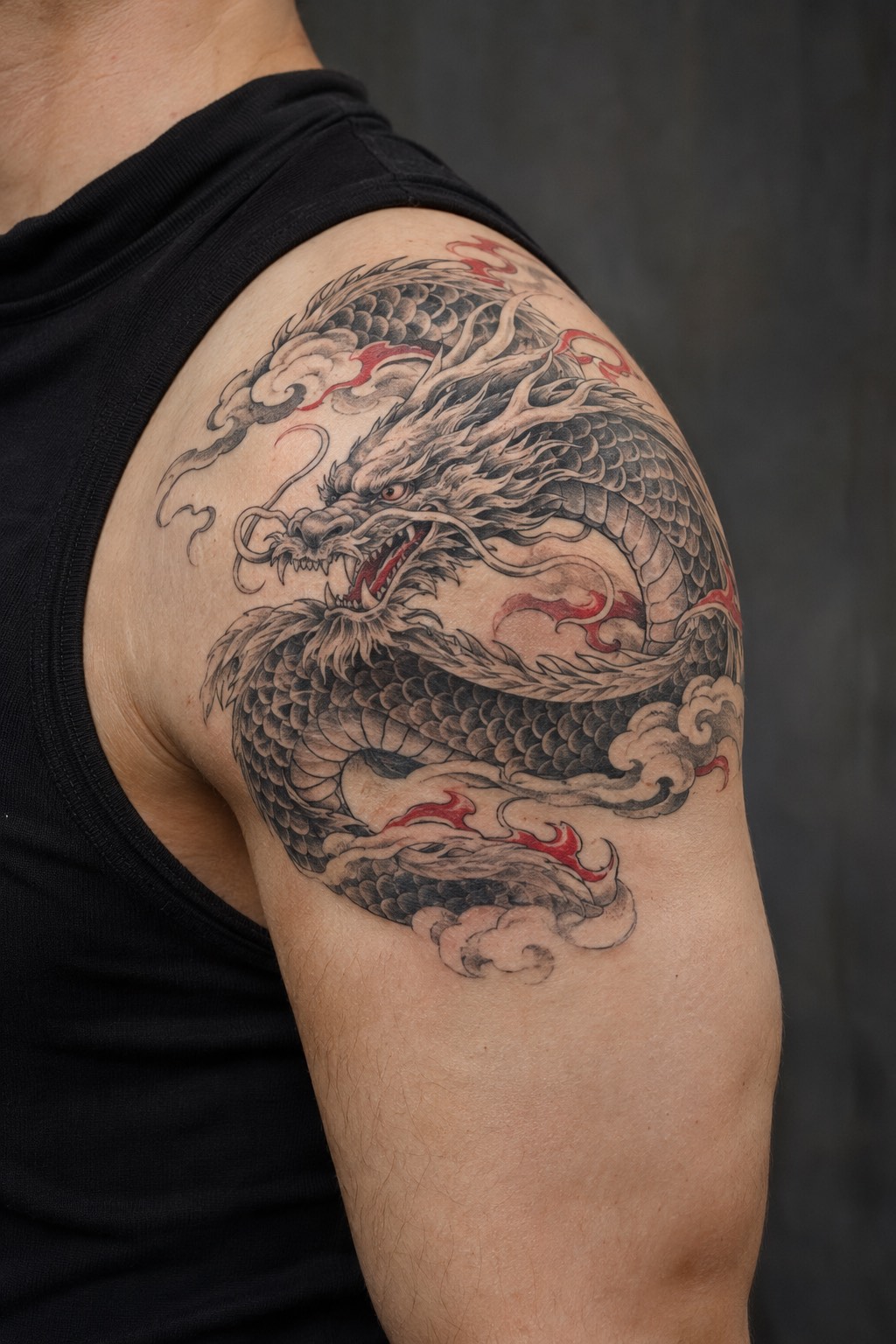
Traditional Japanese Irezumi dragons are legendary for their ability to navigate complex bodily terrain. A horned Ryu dragon coiled around the shoulder cap positions its majestic head overlooking the chest, while its serpentine body winds over the deltoid and down toward the elbow. Swirling wind bars and finger waves cradle the dragon, giving the piece relentless kinetic power.
- Design Concept: An East Asian horned dragon with fierce whiskers, detailed scales, and wind bar water crests framing the shoulder.
- Anatomical Flow: Dragon horns crown the upper shoulder, with claws gripping the deltoid muscle belly and the tail spiraling back toward the scapula.
- Artist Technique: We map the primary flow freehand using surgical skin markers to ensure the dragon coils do not pinch awkwardly when the client raises their arm.
05. Celestial Astrolabe and Sunburst Dome
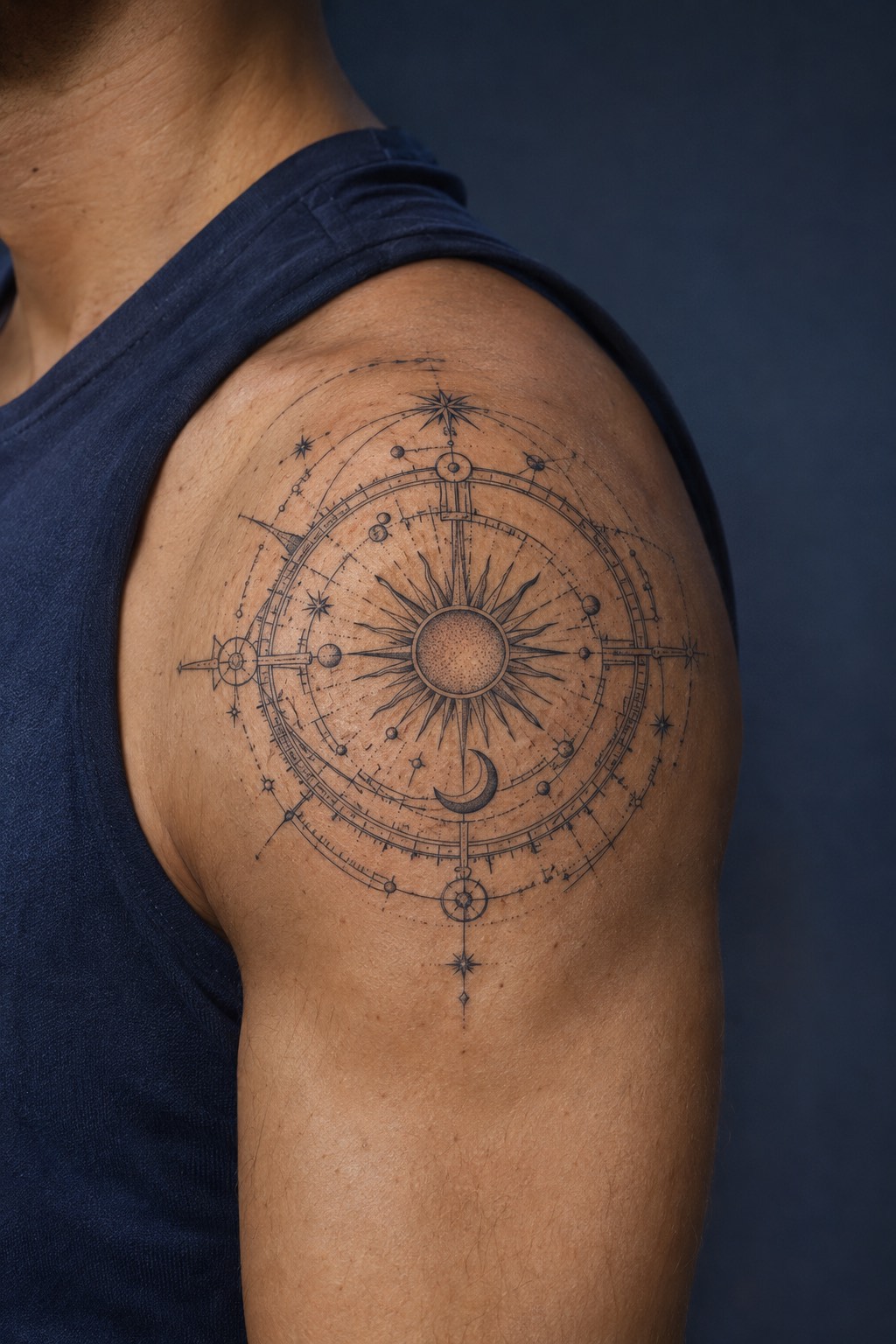
For dreamers, navigators, and lovers of ancient astronomy, an antique celestial astrolabe provides stunning architectural symmetry. The central sphere features a glowing radiant sun, framed by orbiting planetary rings, descending lunar crescent phases, and stippled star maps. The circular geometry sits handsomely over the shoulder apex, reading like a navigational relic.
- Design Concept: An antique brass-style astrolabe featuring alternating wavy and straight solar rays, planetary orbits, and zodiac constellations.
- Anatomical Flow: Sits dead center over the deltoid peak, projecting outward rays that feather softly toward the bicep and collarbone.
- Artist Technique: Executed with a crisp 5RL for primary orbit circles, followed by micro-dot stippling with a 1RL bugpin to capture distant celestial nebulae.
06. Fine-Line Cascading Wildflower Wreath
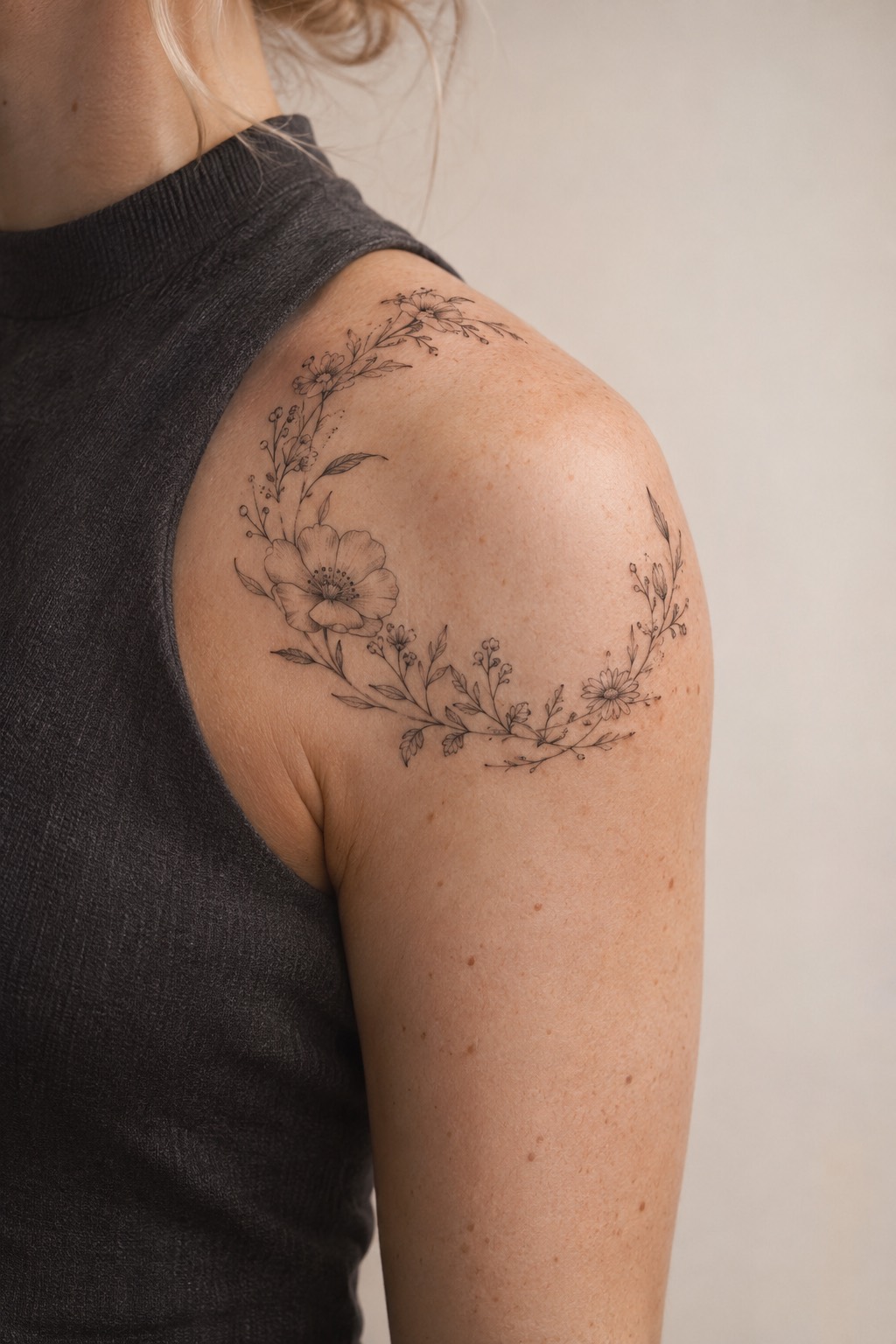
If you want an airy, botanical look that feels light and effortless, a fine-line wildflower wreath is an exceptional choice. Entwined stems of field chamomile, lavender florets, baby breath, and eucalyptus wrap in an organic horseshoe arc around the deltoid. The abundant open skin breaks give the piece breathing room, creating an ethereal frame that complements sleeveless clothing.
- Design Concept: A delicate botanical garland of mixed wildflowers, meadow grasses, and climbing leafy vines.
- Anatomical Flow: Horseshoe garland contouring the front, top, and rear deltoid borders while leaving the muscle center open.
- Artist Technique: Single-needle (1RL) execution with feather-light hand pressure. We vary grey wash concentrations between 5% and 25% to render petal translucency.
07. Neo-Traditional Prowling Lioness Crest
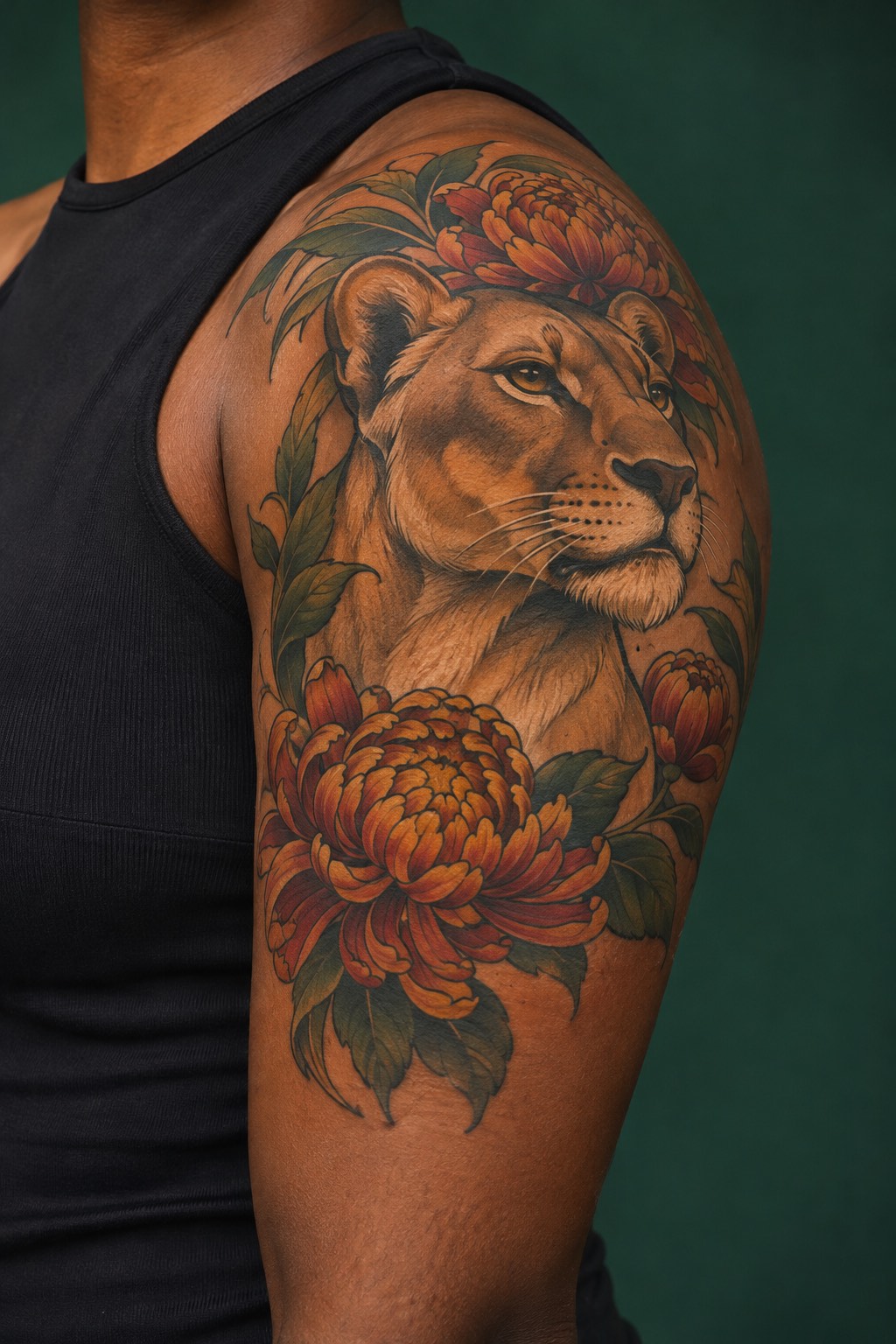
Big cats carry timeless symbolism of fierce maternal protection, raw courage, and independent grace. A stylized neo-traditional lioness head, framed by golden marigolds and rich emerald foliage, commands the broad expanse of the shoulder. The muscular contour of the deltoid lends natural jawline volume to the predatory portrait, making the lioness look alive as you move.
- Design Concept: An expressive lioness portrait with amber eyes, crowned with autumnal blossoms, berries, and ornate jewelry chains.
- Anatomical Flow: Center front-to-lateral shoulder cap, ensuring the face looks directly outward rather than distorted into the armpit.
- Artist Technique: Bold 7RL outer structural lines are paired with soft 15-curved magnum color blending, packing rich ochres and creams for a smooth coat texture.
08. Sacred Geometry Concentric Torus Rings
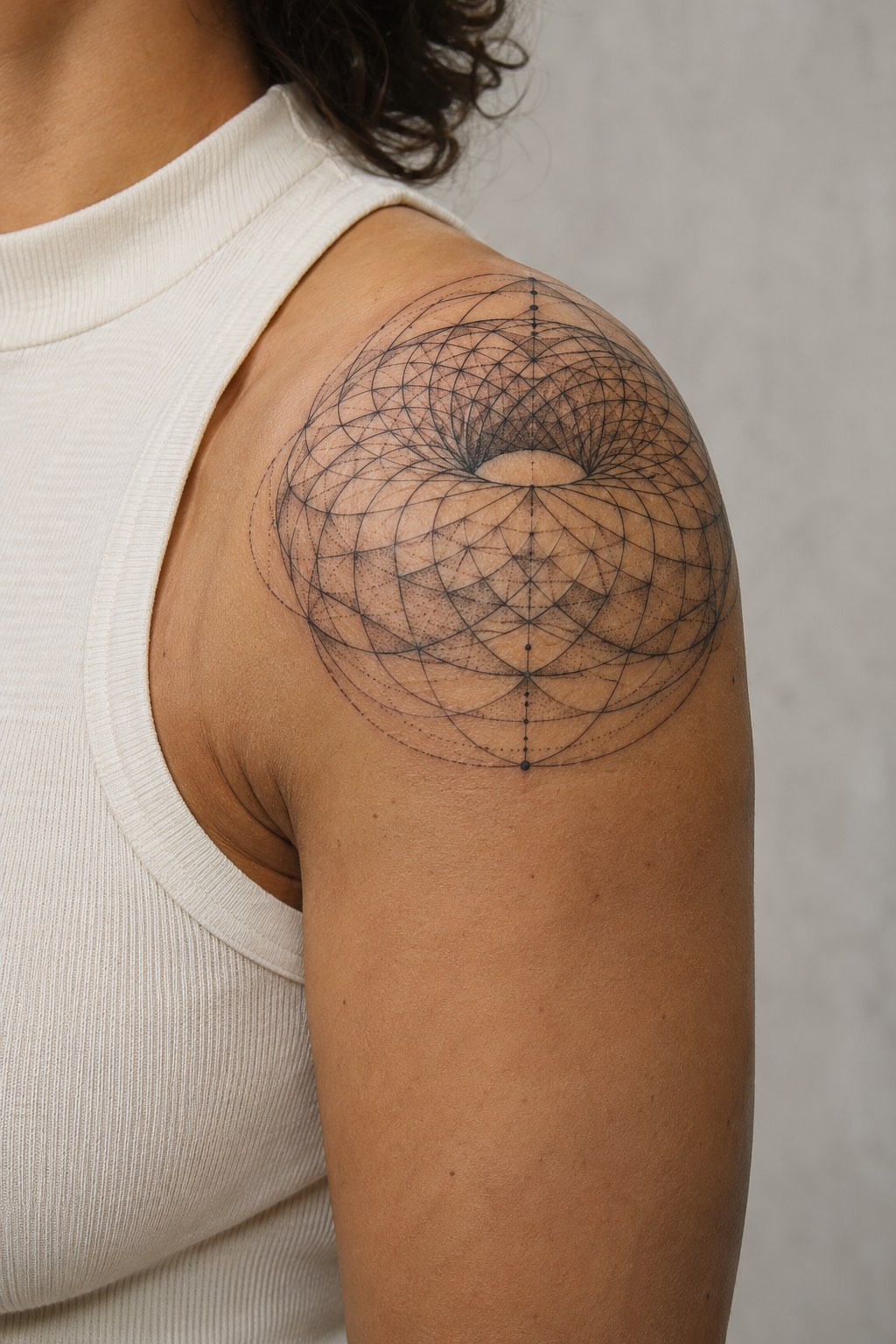
For minimalists who crave futuristic mathematical precision, geometric torus rings turn the shoulder into a modern architectural dome. Interlocking geometric bands and sacred isometric lines rotate around a central vortex on the shoulder bone. The mathematical rhythm creates an eye-catching hypnotic effect that flatters athletic, toned shoulders.
- Design Concept: Hypnotic sacred geometry torus rings, nested platonic solids, and graduating optical illusion lines.
- Anatomical Flow: Centered over the deltoid apex, rotating outward along the front and lateral deltoid contours.
- Artist Technique: Requires laser-guided stencil alignment. Lines are tattooed with a steady, single-pass 5RL needle, maintaining consistent hand speed to prevent ink saturation variance.
09. Classical Greek Medusa Bas-Relief
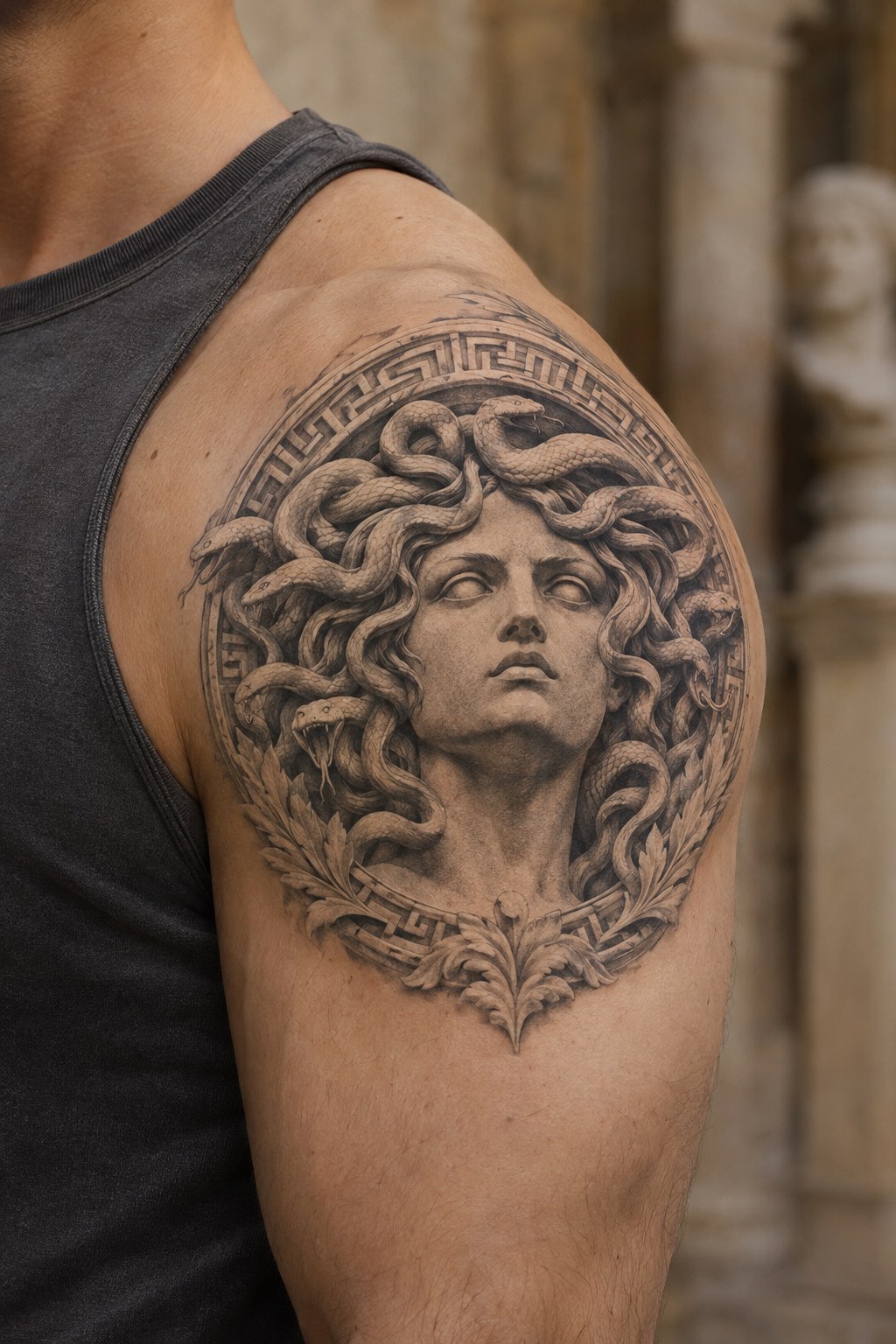
Emblematic of sacred boundary defense and feminine sovereignty, Medusa remains one of the most powerful shoulder designs. Presented here as a classical neoclassical marble relief, her calm, mesmerizing face is crowned with lifelike coiling vipers that billow outward across the deltoid and collarbone. The stone texture creates dramatic museum-grade elegance on the arm.
- Design Concept: A carved marble bust of Medusa with piercing eyes, surrounded by coiling serpents and Hellenistic acanthus leaves.
- Anatomical Flow: Face is centered on the lateral deltoid, with serpent tails spilling across the clavicle and tricep seam.
- Artist Technique: Smooth black and grey micro-realism shading using carbon washes. We leave untouched skin highlights on the high points of the nose and cheekbones to simulate lit marble.
10. Spreading Raven Wings Armor Wrap
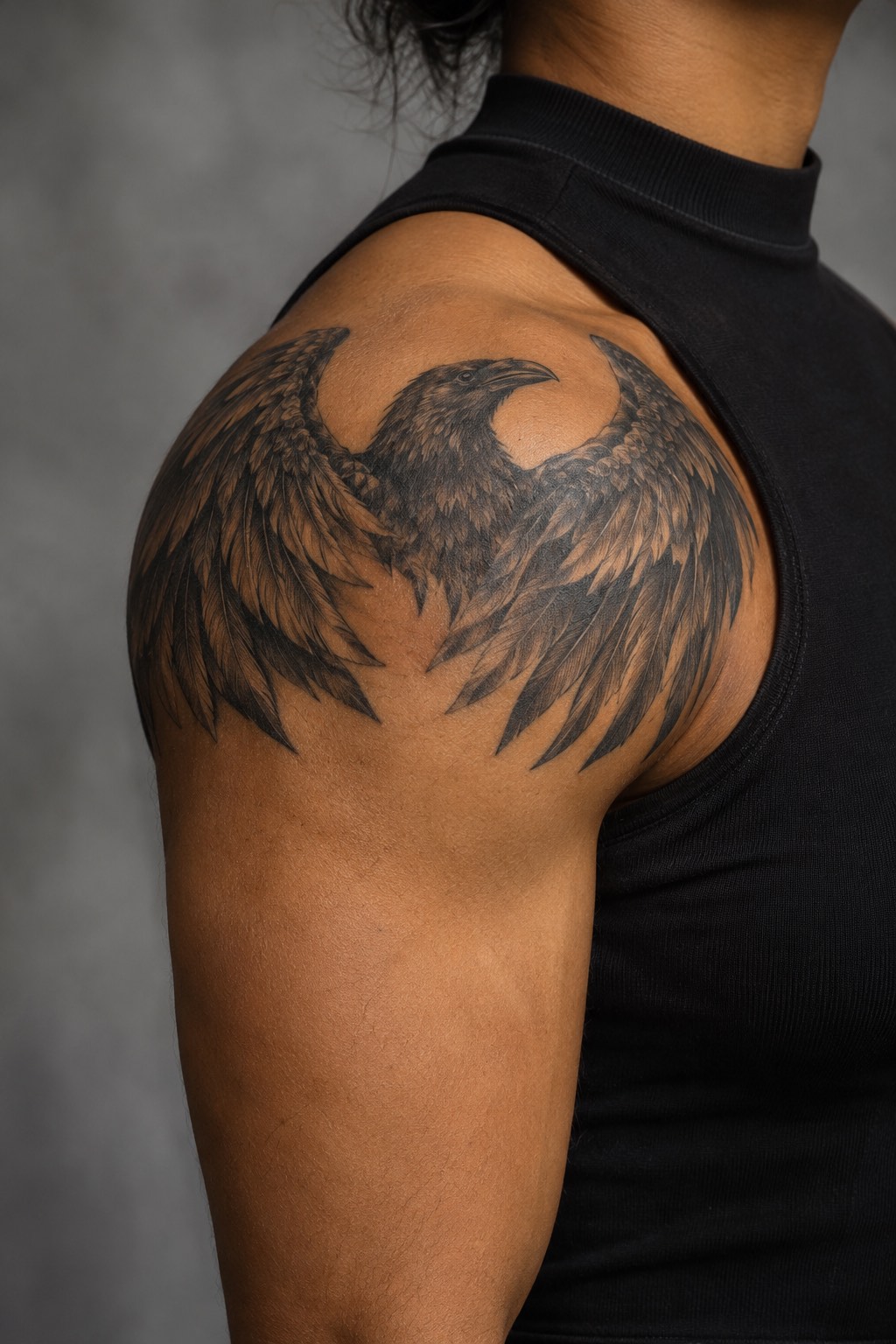
Evoking Norse mythology, Gothic romance, and winged warrior armor, a pair of articulated raven wings wraps the shoulder cap in dark majesty. The wing joints fold neatly over the top of the shoulder, while long primary flight feathers fan out across the bicep. The feathers create a layered, protective silhouette that moves naturally with every arm extension.
- Design Concept: Hyper-detailed black raven wings with layered covert feathers, ragged flight edges, and subtle blue-grey sheen highlights.
- Anatomical Flow: Wing crest hugs the upper trapezius ridge, with outer flight feathers curving down around the outer deltoid.
- Artist Technique: Feather textures require individually pulled hair strokes with a 3RL needle, grounded by deep 80% black wash near the feather shafts to establish true depth.
11. Baroque Lace and Hanging Chandelier Crystals
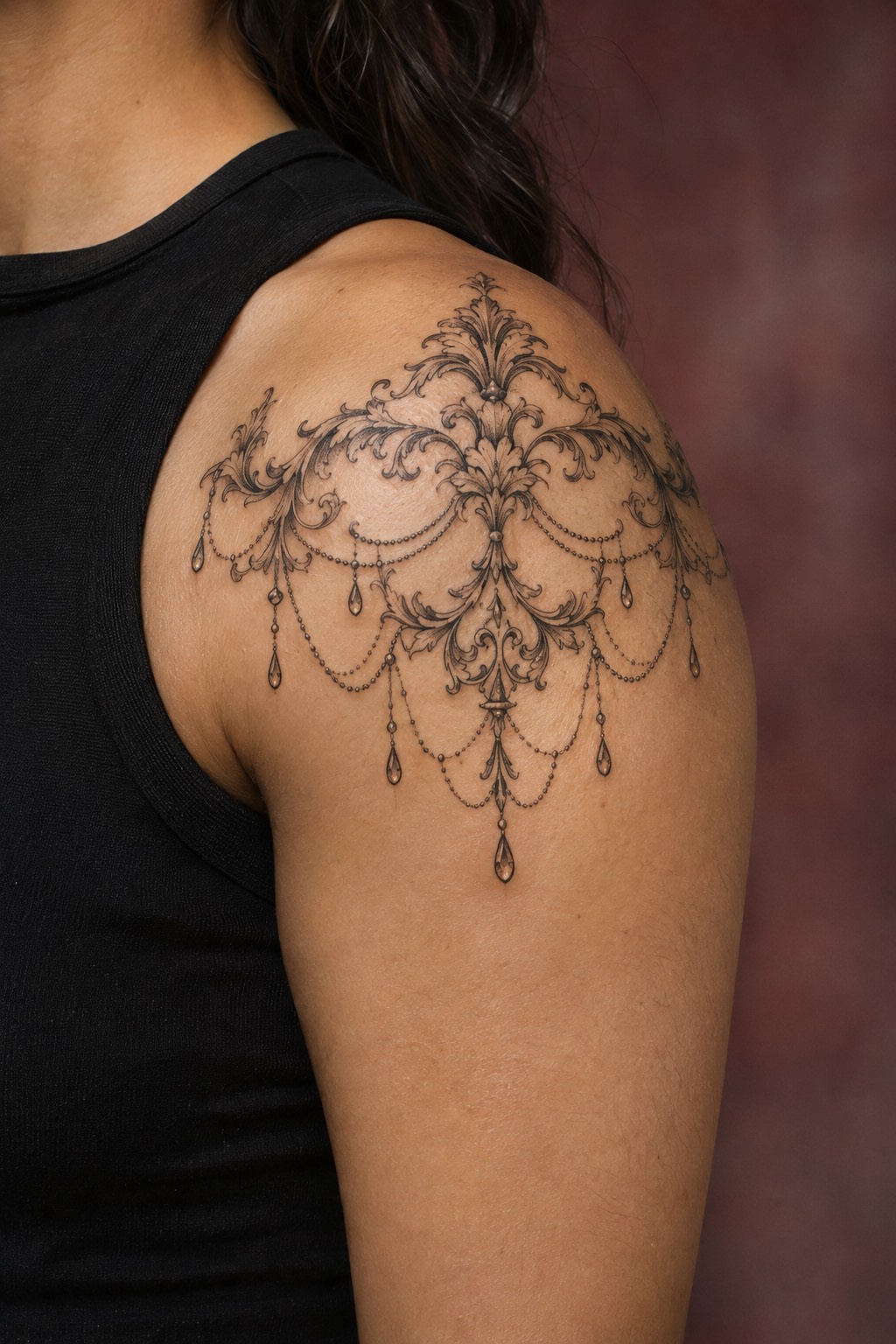
Like an exquisite piece of haute couture, this design drapes the shoulder in vintage Venetian lace and faceted crystal beads. Scalloped lace trims hug the upper curve of the arm, while suspended crystal droplets and delicate chain links cascade downward. It turns the shoulder cap into an intimate piece of permanent jewelry.
- Design Concept: Intricate scalloped Chantilly lace webbing accented by baroque scrolls, teardrop crystal gems, and micro-pearl chains.
- Anatomical Flow: Forms a tailored epaulet over the shoulder crown, with hanging crystals tapering down to mid-bicep.
- Artist Technique: Micro-detail lace patterns are applied with a 1RL bugpin. We pack pure opaque white ink into crystal corners to create glistening reflections under ambient light.
12. Mythological Phoenix Fire Crest
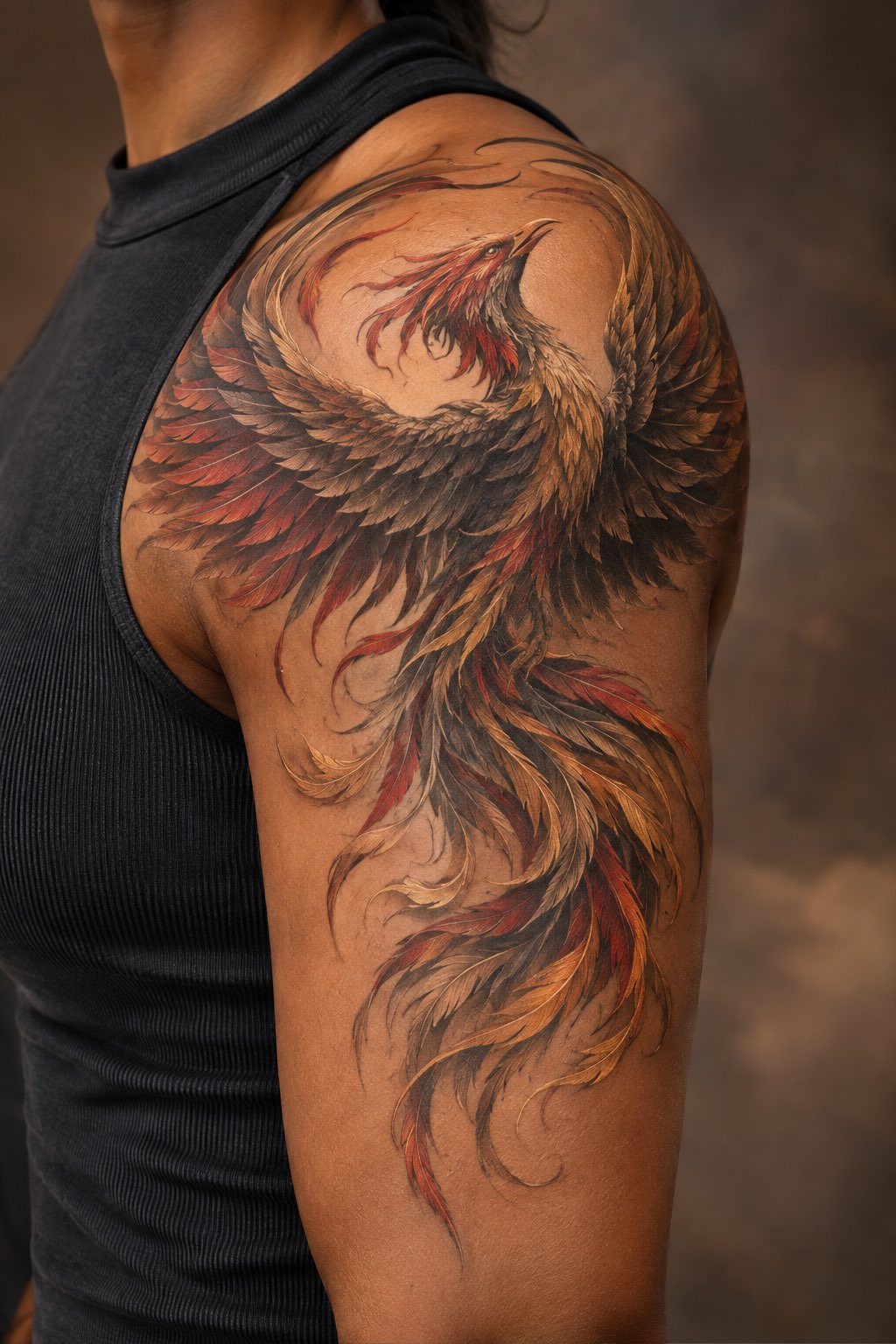
The phoenix represents rising triumphant from hardship. Sized to occupy the full shoulder cap, the mythical firebird ascends toward the neck with spread wings that cradle the deltoid. Its long, calligraphic tail feathers spiral gracefully down the lateral bicep, creating an uplifting visual flow that accentuates athletic posture.
- Design Concept: A rising phoenix with ornate crested feathers, spread wings, and flowing calligraphic flame ribbon tails.
- Anatomical Flow: The bird body crowns the shoulder cap, with wings framing the collarbone and tail plumes sweeping down the arm.
- Artist Technique: We use dynamic line weight variation: bold 7RL lines for the wing bones and whisper-fine 3RL strokes for the fiery tail wisps, creating a sense of weightless ascension.
13. Fine-Line Botanical Olive Branch Arc
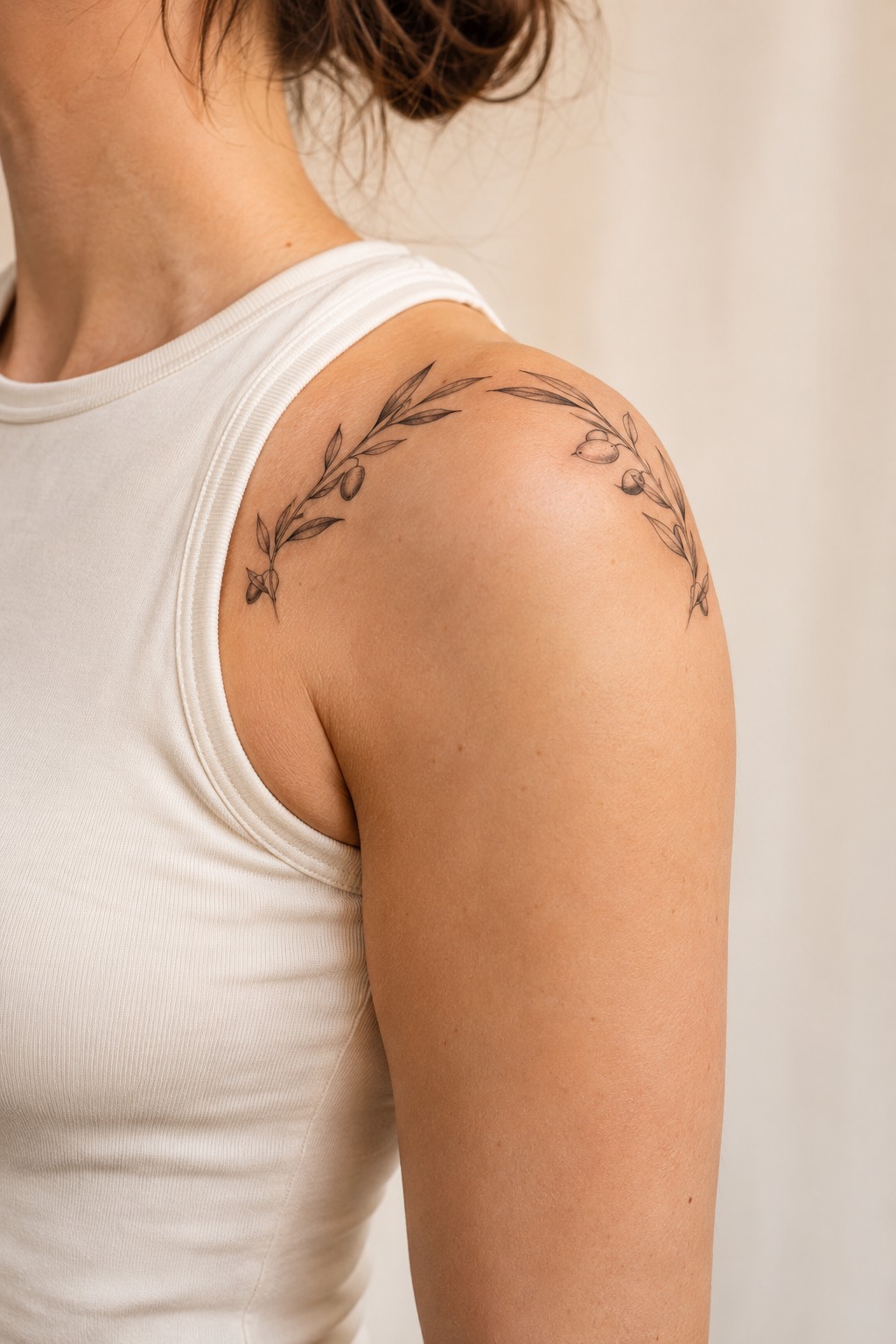
Understated, organic, and timeless, a curved olive branch arc frames the deltoid with classical restraint. Alternating pointed leaves and tender botanical olives trace the perimeter of the muscle, highlighting its natural athletic curve without feeling heavy or dark. It is a superb standalone piece that easily integrates into future floral sleeves.
- Design Concept: An organic laurel arc composed of slender olive leaves, budding twigs, and delicate botanical fruit.
- Anatomical Flow: Sweeps in a graceful semi-circle along the front and lateral deltoid insertion seam.
- Artist Technique: Executed entirely with a single needle (1RL) or tight 3RL. Open skin gaps between leaves ensure the botanical wreath stays crisp as the skin ages.
14. Traditional Japanese Chrysanthemum and Wave Crest
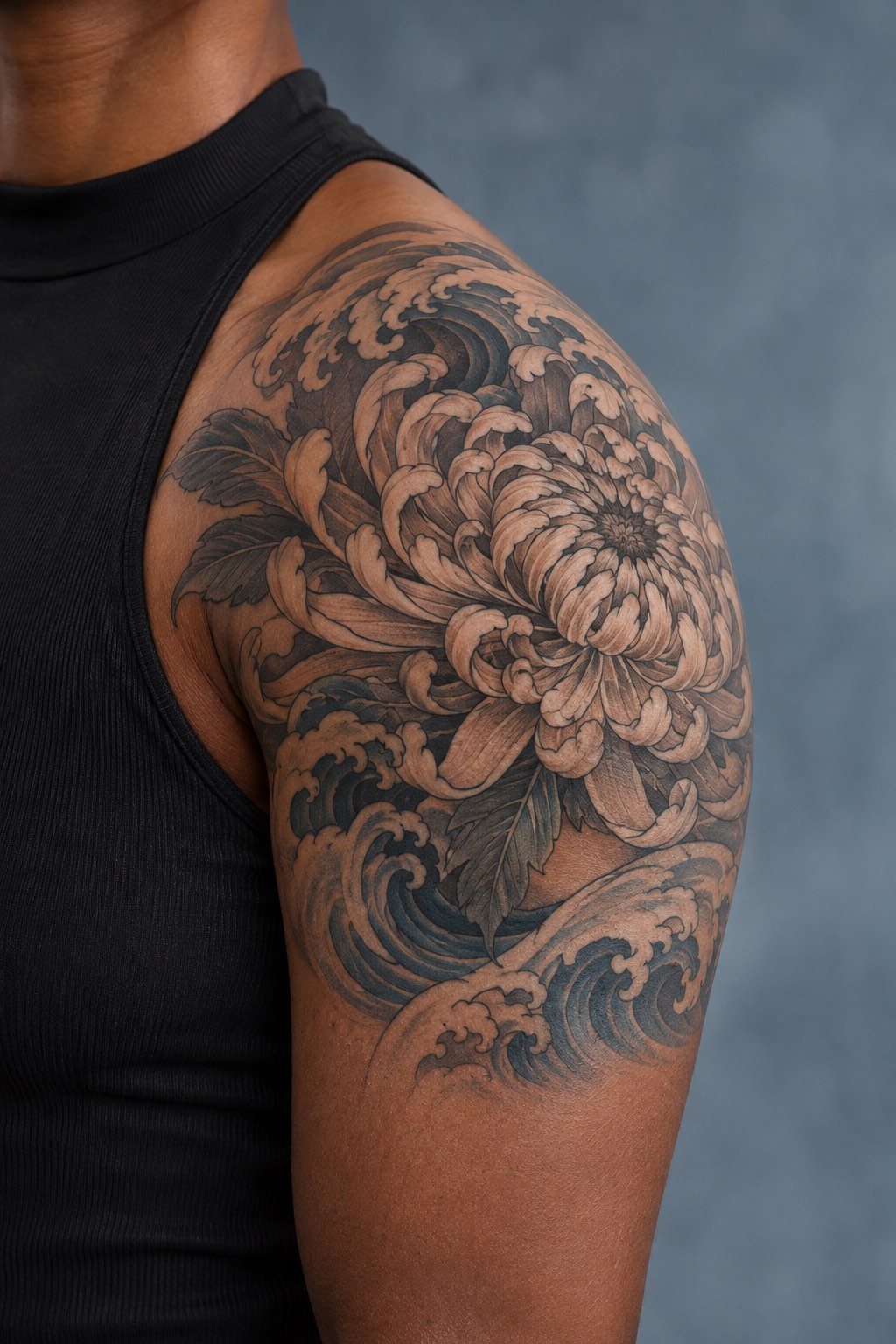
The chrysanthemum (kiku) represents longevity, dignity, and noble character in Japanese tattoo culture. With dozens of tightly curled petals radiating outward from a central bulb, the blossom mirrors the hemispherical dome of the deltoid. Rolling foam-crested waves frame the flower base, providing classic visual weight and timeless movement.
- Design Concept: A large blooming kiku chrysanthemum nestled in curling Japanese water waves and spray droplets.
- Anatomical Flow: The chrysanthemum blossom centers on the shoulder cap apex, with waves wrapping down the upper bicep.
- Artist Technique: Bold, unyielding 9RL outlines create the classic Irezumi skeleton, while smooth black wash gradients give the tightly curled petals sculptural volume.
15. Gothic Cathedral Rose Window Tracery
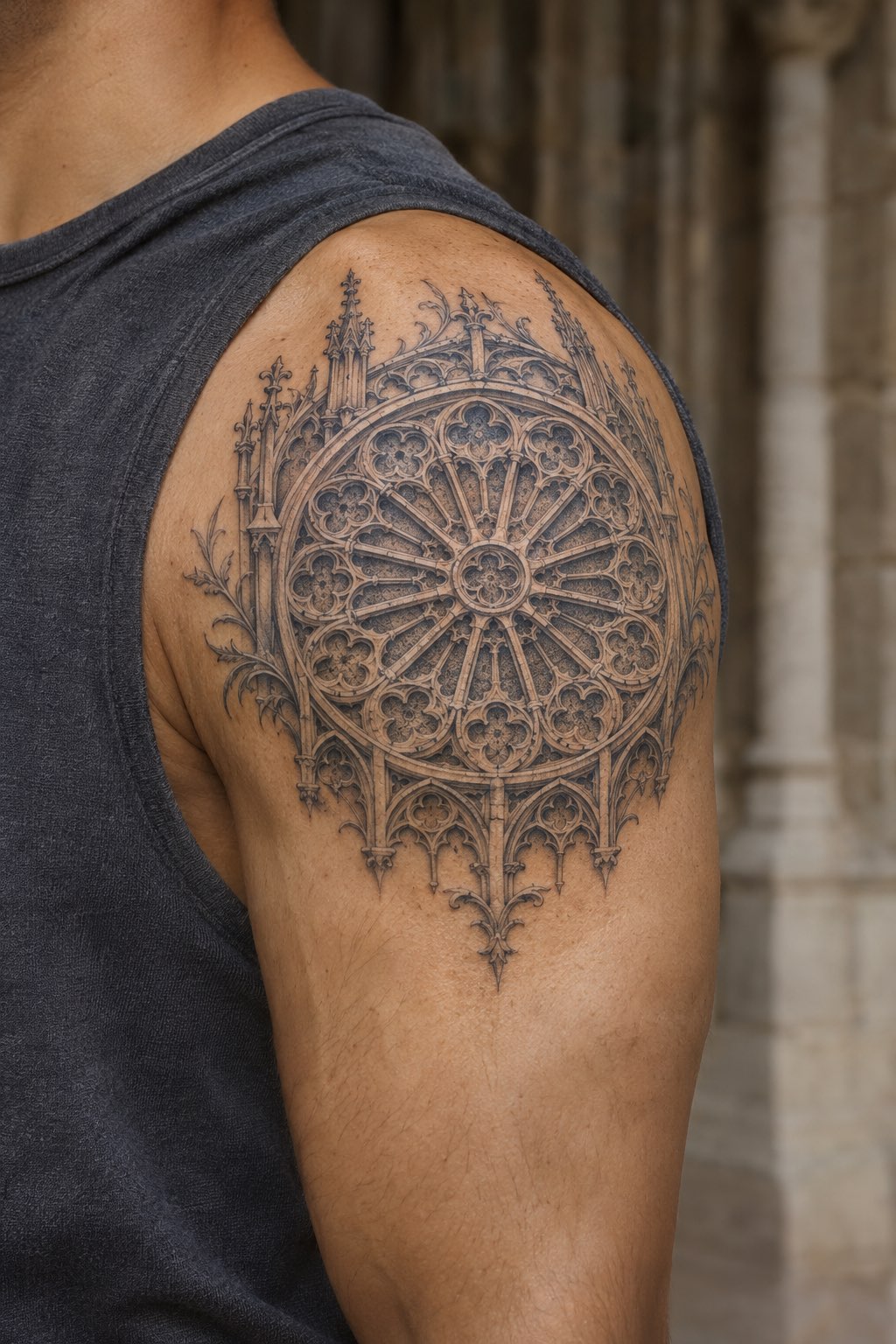
Medieval stained glass rose windows from European cathedrals are celebrated for their breathtaking radial symmetry. Placed directly over the shoulder cap, this design features interlocking pointed lancet arches, trefoils, and gothic tracery rings. The architectural geometry transforms the shoulder joint into a stone-carved cathedral façade.
- Design Concept: A 13th-century gothic cathedral rose window with intricate stone traceries, trefoils, and etched crosshatching.
- Anatomical Flow: Centered over the deltoid dome, radiating outward in concentric stone arches that frame the arm.
- Artist Technique: Stone textures are built with fine-line crosshatching and stipple shading using a 3RL needle. High-contrast negative space breaks mimic sunlight streaming through stained glass.
Mastering the Deltoid Dome: Kinetic Movement and Stencil Placement
Positioning a tattoo stencil on the shoulder cap requires specialized anatomical awareness. Because the shoulder joint has the greatest range of motion in the human body, standard stencil placement protocols must be observed strictly:
- Always Stencil in a Neutral Standing Posture: Never permit an artist to apply a shoulder cap stencil while you are lying down on a massage table or sitting with your arm propped awkwardly on an armrest. Stand tall with your arms hanging naturally at your sides and shoulders square. This ensures lines remain true and symmetrical when you walk and stand in daily life.
- Respecting the Three Muscle Heads: The deltoid consists of anterior (front), lateral (side), and posterior (rear) heads. Designs that flow seamlessly over the lateral peak while tapering softly into the clavicle and scapula feel cohesive, whereas boxy rectangular graphics look abruptly cut off.
- Accounting for Arm Elevation and Distortion: When you raise your arm above your head, the deltoid contracts and compresses toward the neck. Organic motifs such as floral bouquets, dragon scales, and ornamental lace absorb this natural distortion effortlessly, whereas rigid geometric grids or perfect circles will inevitably flex with muscle contraction.
Shoulder Cap Pain Dynamics, Sleeve Transitions, and Healing Protocols
The shoulder cap is widely celebrated among tattoo veterans and newcomers alike for its relatively gentle pain profile, but proper planning and aftercare remain essential for a clean result:
- The Deltoid Pain Profile: The fleshy outer belly of the deltoid is comfortably mild, typically ranking around a 3 out of 10 on the pain scale. However, sensation sharpens noticeably as the needle migrates upward over the bony acromion process, forward across the collarbone, or inward toward the sensitive armpit crease.
- Designing with Future Sleeve Expansion in Mind: The shoulder cap serves as the natural anchor point for full or half-sleeve tattoos. If you plan to extend the artwork down your arm or across your chest in the future, instruct your artist to leave soft, open-ended borders (such as wind bars, smoke wisps, or fading leaves) rather than a blunt horizontal baseline.
- Healing and Clothing Friction Protocol: During the first 14 days of healing, avoid tight bra straps, heavy backpack straps, or tight-fitting jackets that press directly against the shoulder cap. Friction from repetitive arm movement can irritate fresh epidermal tissue and pull scabs prematurely. Wear loose, breathable cotton t-shirts and apply a micro-thin layer of fragrance-free lotion twice daily.